Heading off to ICHEP

See also Chapter 3.4 of Smashing Physics.

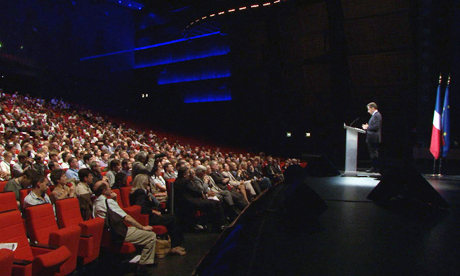
I’m writing this on the Eurostar at St.Pancras, waiting for it to pull out of the station and take us to Paris, and the International Conference on High Energy Physics (ICHEP).

Of course there are many international conferences on high energy physics, it’s a completely international subject. But there’s only one ICHEP. Well, one every two years, anyway. And this, after many promises and a false start, is the ICHEP where first data from the Large Hadron Collider (LHC) will be presented to the world.

The rest of this post is on the Guardian Science blog.

Share

Posted in Particle Physics, Physics, Physics Stories, Science, Travel | Tagged , , , , , , | Comments Off on Heading off to ICHEP

Quarks, Gluons and Jets

An updated version of this post is now on The Guardian. See also the glossary section after Chapter 1.5 of Smashing Physics.

Yesterday we (ATLAS) released our first (preliminary) jet cross section measurement.

“Cross section” in this context is basically a probability. If you fire two footballs at each other, they have a bigger cross-sectional area than two snooker balls, so they are more likely to hit each other. A “jet cross section” is a measure of how likely we are to see jets when we fire two protons at each other.

An ATLAS event with two jets.

Jets are what quarks and gluons do when they try to escape. The proton is made up of quarks stuck together by gluons (the name gluon is itself, I guess, an early geekjoke). Most of the fundamental forces get weaker with distance – the Earth’s gravitational pull gets weaker the the further out into space you go, for example. But the strong nuclear force is the other way round.

Continue reading

Posted in Particle Physics, Physics, Science | Tagged , , , | 6 Comments

Self Reference

I guess every blogger has to blog about blogging at some point. I was on a panel of science bloggers at a talkfest organised by Alice Bell and Beck Smith last week, so it has been on my mind, and this is my self-referential blog. If you are not up for a bit of navel-gazing, move right along. But see also Chapter 1.6 of Smashing Physics.

First – thanks to everyone; organisers, bakers, fellow panelists and audience. Weird but stimulating experience walking into a room full of people 90% of whom you have never met but have exchanged tweets with. Glad to have met lots of you now.

Somewhere between Gospel Oak and Barking, taken by Leon. Something to do with windows also being mirrors?

One, fundamental, question was: Why blog? The answer I gave was that I got into it because of the opportunity and interest provided by the LHC startup, and basically can’t keep my mouth shut. The mouth was probably more obvious in the pub than on the panel, but writing is the point here. I really enjoy writing in general. Writing scientific papers is fun and challenging, and I even try to make them interesting sometimes, but the blog provides more scope for creativity and fun.

I know there’s a continuum, from scientists who blog a bit through to full-time professional writers who report and explain a wide variety of science done by others. I’m near the former end of the spectrum.

On a Mission From…?

Several commenters felt that science bloggers lacked ambition. Don’t we want to change the world?

Continue reading

Posted in Climate Change, Science, Science Policy, Writing | Tagged | 10 Comments

Engineering a Decline?

See also Chapter 3.3 of Smashing Physics.

In a way, I am quite impressed by the Royal Academy of Engineering. They have managed to speak very clearly in response to some difficult questions from our new political masters. What they have to say, however, is pretty depressing.

Their “central belief” is that the priority for government-funded science and engineering research should be:

rebalancing of the economy away from financial services and towards a high-technology based manufacturing sector

ATLAS barrel silicon detector, built in the UK. Photo credit STFC.

This may make sense. I see real deficiencies in the way the UK trains and treats people of who are technically skilled, compared to some of our competitors (I’m thinking particularly of Germany and France, where I have some direct experience). I have a feeling that we place too much emphasis on marketing and management, as though these have value independent of the things they are marketing or managing. But this is not much more than a gut feeling, and unfortunately the RAEng document doesn’t provide any evidence to bolster my prejudice. A missed opportunity, assuming they have such evidence.

Equally evidence-free, and infinitely more depressing, is the way the RAEng think the government should go about achieving this:

The over-riding consideration for BIS should be the impact of research on the economy in the short to medium term

and the way to do this is to ensure that:

the available Science and Research budget should be targeted where it will have most impact in the  foreseeable future

Naively I would have thought that this “foreseeable future” stuff was precisely where private-sector research should take the lead, rather than the public sector, since foreseeable impact presumably means there’s a market. But actually maybe the public sector is better at this than the private sector. Perhaps a command economy is actually the way forward. They’re probably right. Whitehall, and governments in general, are notoriously good at spotting the next transformative technology wave, of course.

Continue reading

Posted in Particle Physics, Politics, Science, Science Policy | Tagged , | 27 Comments