
When Catherine Heymans, Simon Williams and I gave evidence to the House of Commons Science, innovation and Technology select committee a few weeks ago (seems like years to be honest), we were set some homework.
Kit Malthouse MP asked about the career destinations of people trained in particle physics, astronomy and nuclear physics (PPAN), and Chi Onwurah, the chair, said
Maybe you could write to us about how we could capture that— about a question we could ask or a figure we could give, so that we can capture that and see the impact.
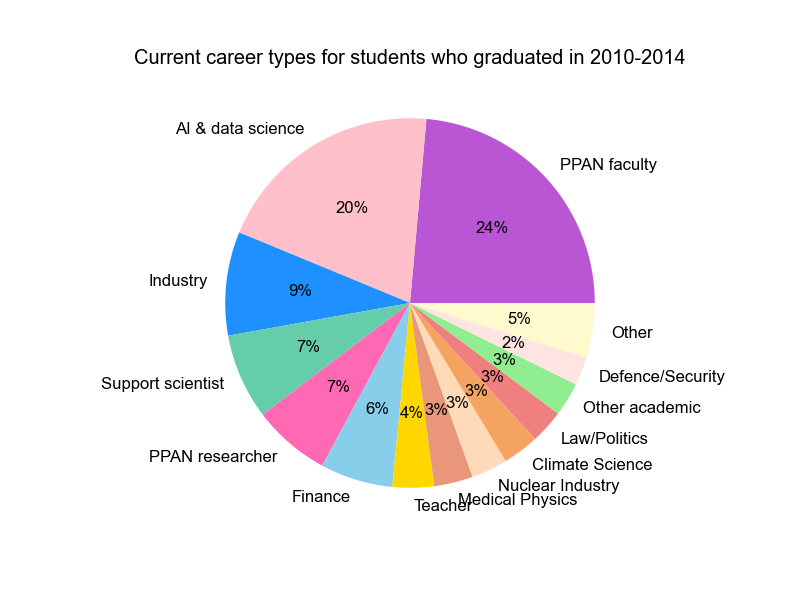
This information is only available piecemeal, so to get a snapshot we circulated a questionnaire to as much of the PPAN community as we could, Catherine did a rapid analysis, and we sent this in to the committee. It is now available from their web page.
The best summary is to take a look at it (with pie charts!) but he TL;DR version is: we go all over the place, especially into fast-moving and cutting-edge technical areas. After about 15 years, roughly a quarter of us are university faculty working in the PPAN science areas; of the very diverse set of other destinations, AI and data science currently dominate, with about a fifth of us; that fraction is even higher for more recent graduates.
I hope and believe that this kind of evidence, and the discussion around it, has had some influence on the annoucement that the planned decline in postdoctoral positions in these science areas has been halted (albeit at the historically low level of the 2025-2026 financial year). I hope it will also help us make the case for some recovery and growth. This is a good investment for the UK.
* and astronomers and nuclear physicists and accelerator physicists


