
Higgs bosons produced with high transverse momentum are a key probe for new physics.
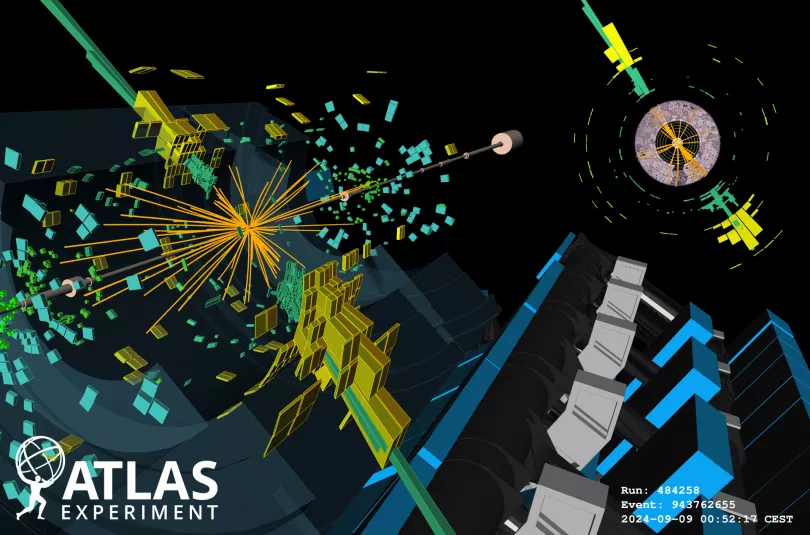
An event display of a possible Higgs boson event showing two back-to-back jets. One jet shows a clear separation of energy deposits (in green) which is a sign of the Higgs decay.
Since the discovery of the Higgs boson back in 2012, one of the most important things we have been doing at the CERN Large Hadron Collider (LHC) is measuring how Higgs bosons are produced and how they decay. The Higgs is a vital, singular and relatively unexplored feature of the Standard Model of particle physics. Measuring its properties and dynamics is a really promising avenue for pushing the limits of that model, and looking for clues to how it might be extended to explain some of the things it currently cannot1.
The energy of LHC collisions is such that Higgs bosons can be produced with a lot of kinetic energy – that is, with a high Lorentz boost. Back in 2008, just before the LHC started up, a few of us realised that since the Higgs often decays to bottom quarks, a common signature of a boosted Higgs boson would be a single “jet” of hadrons, and that to identify this, we needed to understand the substructure of that jet2. This involves understanding the strong interaction, which is challenging, but understanding had improved a lot thanks to the efforts of theorists and data from the previous generation of experiments. So we thought we could do it.
The general idea spawned a whole series of “BOOST” conferences, and it soon became clear that Machine Learning (since rebranded as Artificial Intelligence) would be a powerful tool in learning the jet substructure and picking out Higgs candidates.
Boosted Higgs events have contributed to Higgs measurements over the past few years, especially for events where Higgs bosons are produced in association with a W or Z boson. But a clear, significant measurement of boosted Higgs bosons needed more data and better techniques. That has now been achieved in an analysis by ATLAS, with big contributions from UCL colleagues working in our Centre for Doctoral Training for Data Intensive Science and Industry. The ATLAS “physics briefing” gives more detail, and this UCL news item emphasises our contributions and the wider impact.
I am sometimes made unavoidably aware that I have been around for a long time. Mixed feeling about that, in general. However, seeing a result like this, pulling together so many ideas and efforts from so many people, and not only being the culimination of that work but also demonstrating huge potential for the future and our upgraded machine and detectors, is definitely one of the good feelings
- My personal top list is: Dark Matter, why there is more matter than antimatter, and why there are three generations of particles. I would like to know about quantum gravity too but I think the chances of the LHC helping with that are small. Though I might be wrong. ↩︎
- In fact this was the subject of my first ever blog post. ↩︎


