Also at The Guardian.
 I started writing about neutrinos because I love them. They are quite magical really; the Universe is completely swarming with them (they are the second most abundant particle after photons) but we know practically nothing about them. And what we do know is really weird. I wrote down “My favourite particle: the neutrino” to fit in with the other particle articles. But it isn’t my favourite particle. I toyed with “Not my favourite particle: the neutrino” but that just felt disrespectful. Then I decided it doesn’t matter what I write at the top of the page. Why do I need this post to fall into line with the others? I suppose it’s because I want symmetry. I want that warm, comfortable-yet-exciting feeling you get when starting to read the next book in a trilogy.
The neutrino was postulated (imagined-up) for a similar reason: the desire for symmetry.
A hundred years (ish) ago there was lots of great experimental science going on. There was no clear idea what atoms were, but there was an understanding that they weren’t solid balls. Ernest Rutherford and others had established, through experiments, that there was a nucleus in the center of an atom and had postulated that electrons were ‘in orbit’ around this nucleus. He came up with this description based purely on his experimental results: there was no theory at the time that predicted this.
I feel quite nostalgic for this sort of experiment-driven theory. In the era of the LHC it is not the done thing to come up with a new theory to describe what we see experimentally. In general, our results have to fit some theory that has already been proposed. When they don’t (they don’t) we tune the theoretical predictions to match our data, like twiddling a load of knobs (most of these theory predictors, which we call Monte Carlo, have twenty or thirty knobs) until we get some agreement. I am moaning about this, but really we don’t have a choice.
Anyway, back to the good old days.
Something called Beta decay had been observed. They had a name for it before they knew it for what it was. It was a nice bit of real-world, useful, observational science. It was noticed that some atoms would emit radiation without any provocation to do so.
This is what we call radioactivity. Active radiation. Nothing to do with the radio, other than that radio also works via radiation. Radio is carried by electromagnetic radiation (my first love- the photon). What radiation is is the loss of energy by something. That energy invariably travels somewhere else in some form or other. But the thing with radioactivity is it is not deliberate. It just happens “naturally”.
When first discovered it triggered a whole host of money-making schemes, similar to modern-day homeopathy I suppose, except homeopaths make their millions out of plain water and packaging, whereas back in the day the quacks were raking it in by selling people radioactive face-cream. The scientists rebelled, lots of people got cancer and the business end closed. I laughed at these adverts and showed my mates, and then I felt really sad because I thought about people in the future (okay, the present) laughing at my friends for buying 0% proof hogswart.
Anyway (again), the science continued, and we realized that what was happening was that part of the atom, in fact part of the nucleus, was ‘decaying’.
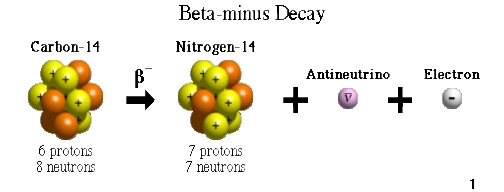
It was established that the radiation being emitted was electrons, because the measurement of the emitted particles’ charge and mass was exactly the same as for electrons. The electrons weren’t being thrown ‘out of orbit’, they were being emitted from the nucleus. This is interesting, because the atomic nucleus only contains protons (with a charge of +1) and neutrons (with a charge of zero). To get a negatively charged particle out of this we tho ught that the neutron must decay into a proton and an electron: zero charge= +1 and -1. Great. This fitted nicely with the experimental measurement of the atom before and after it went through Beta decay.
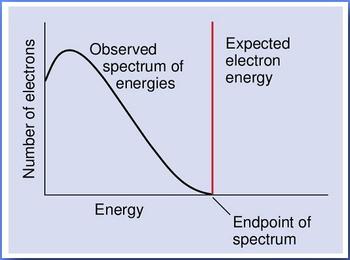
But this is where things stopped being comfortable. This picture predicts precisely the energy that the emitted radiation (the electron) must have. Depending on what kind of atom is doing the decay, we should be able to predict exactly how much energy the electron has.When they measured the energy carried by these emitted electrons, they found that the electrons could have any energy. This was a huge problem because conservation of energy was (and is) the closest we get to feeling comfortable with any knowledge in particle physics. It always works. We don’t have to appeal to the fact that the theory is beautiful and elegant, we just do cold, hard experiments. And warm, soft ones. Any kind of one. We always get the same answer: energy is conserved. Always. But not in radioactivity.
Wolfgang Pauli wasn’t having any of it. There must be something else emitted, something that the instruments were not detecting. Pauli described the properties that this invisible particle must have; It is neutral (no charge), it has a small (or zero) mass and it has spin half like the electron. If the new particle was emitted along with the electron, then the electron could have any energy, because the total energy emitted could still add up to be the exact value predicted by the theory. The new particle would have to be a ghost, traveling through matter without interacting at all. Then we could explain why it was not detected.
Of course this was not a comfortable place to be, but it was slightly less uncomfortable than violating the law of conservation of energy.
Pauli was aware of his responsibility, famously saying “I have done a terrible thing. I have postulated a particle that cannot be detected”.

Wolfgang Pauli: he knew his stuff.
Is it okay to make a prediction that we cannot test? Science is about trying to describe the way the world works; our understanding should be based on what we observe and our theories should be testable. This is why some experimentalists laugh at string theory. I for one am happy to ignore it until someone comes up with a way for us to test its validity. Okay, some of the reason I ignore it is because it is hard, but I would be much more inclined to make the effort if I thought it was any use.
Thankfully, the little neutral ones, neutrinos, can be detected. It is just very, very difficult to do. This is because they simply do not interact with the particles that make up matter. Neutrinos can fly past an atom as if it were not there. They are neutral, so they are not affected by electromagnetic fields. The only thing in nature they have anything to do with is the weak nuclear force, so they tend to just whizz through the universe, through planets and through us, leaving no trace.
We do detect the odd one. The first was 25 years after Pauli’s prediction, by Cowan and Reines. Back in 1987 we saw a whopping 24 of them in just a few seconds, thanks to a supernova going off in the vicinity. But generally they are a bugger to catch.
So what do we know about neutrinos now? Almost nothing, but the little bit we do know is very interesting indeed. The standard model of particle physics (the theory that we are most happy with when putting together all the little bits of knowledge we have gathered from thousands of experiments over a hundred years) tells us that neutrinos have no mass, like photons. We now know that this is not the case. Neutrinos do have mass. We know that the three kinds of neutrinos must all have different masses, so at least two of them cannot be zero. I feel like nobody really talks about this. Perhaps I hang out with the wrong kind of physicists. Neutrino experiments have shown the standard model to be deeply flawed, yet we still persist in calling it “the standard model”.
I have finished writing this now without actually saying a single thing about why I love the neutrino. I haven’t mentioned that they are able to change flavour (neutrino oscillations) or that they could be their own antiparticle (are they Majorana or Dirac particles?) or that they can help us understand dark matter, or that the fate of the universe is in their hands.
Each one of these things is completely deserving of its own post, written by someone who knows their onions and is able to write something that is not 90% digression.