
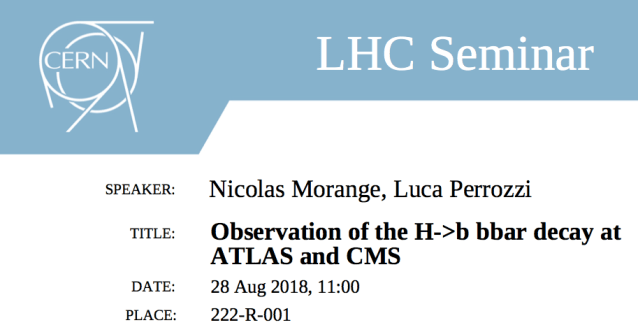
This morning two results appeared on the arXiv:
This morning two results appeared on the arXiv:
This went up on the government webpages yesterday: Horizon 2020 funding if there’s no Brexit deal.
In a way it is comforting that someone in government thinks enough of scientific research to even mention it in the current Mayhem. The restatement of the guarantee of continued funding from the UK for current EU funded projects, even in a no-deal scenario, is welcome.
They have even noticed that money alone doesn’t solve the issue, since UK scientists are the leaders of some projects, and so receive money from the EU and disburse to the rest of their collaboration, all over the EU and beyond. The UK isn’t going to fund all that, but if there’s no deal, the EU will stop sending the money. So this is a “no deal” contingency that needs a deal. Erm. Still, it is a time-limited problem, as the idea of the UK leading anything European belongs to an already-fast-receding golden age.
The ALPHA experiment (no relation) at the CERN antiproton decelerator has just published the first measurement of the Lyman-alpha lines of anti-hydrogen (a positron bound to an antiproton)¹.
There is an excellent summary of the measurement here, written by Ana Lopez.
Ana mentions the importance of the Lyman-alpha line to astrophysics. As light of multiple frequencies travels to us from distant objects, it passes through clouds of interstellar and intergalactic hydrogen. The Lyman-alpha energy transition of hydrogen “takes out” various frequencies, depending on the red shift, when a photon of the right energy hits a hydrogen atom and makes the electron jump up the level. There’s a video from Andrew Pontzen above, illustrating how, because of the different red shifts, a single energy transition leads to a “forest” of absorption lines.
At the beginning of June 2018, I gave an (academic) talk on the discovery of the Higgs boson at a meeting at Case Western Reserve University (Cleveland, Ohio, USA) to celebrate fifty years of the Standard Model – the SM@50.
 The list of speakers was without doubt the most eminent collection of physicists I have ever been a part of. In alphabetical order, and mostly with links to the reasons for their eminence:
 Life and Physics