Exploring the “Higgs Portal”

The Higgs boson is unique. Does it open a door to Dark Matter?

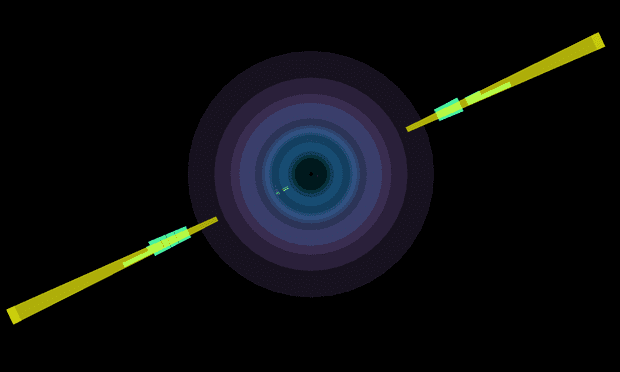
All known fundamental particles acquire mass by interacting with the Higgs boson. Actually, more correctly, they interact with a quantum field which is present even in “empty” space, and the Higgs boson itself is an “excitation” – a quantum ripple – in that field. Either way, what this means is that if you create a Higgs boson, it can and will decay, producing other particles, via those same interactions.
Continue reading

Posted in Astrophysics, Particle Physics, Physics, Science | Tagged , , , | Comments Off on Exploring the “Higgs Portal”

Particle & astro-particle physics annual UK meeting

The annual UK particle physics and astroparticle physics conference was hosted by Imperial this week, and has just finished. Some slightly random highlights.

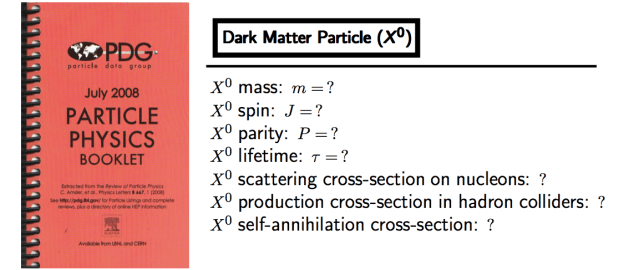
Dark Matter PDG

Goals (slide from the plenary talk by Chris McCabe, KCL)

Continue reading

Posted in Astrophysics, Particle Physics, Physics, Science | Tagged , , , , , , , | Comments Off on Particle & astro-particle physics annual UK meeting

Observation of a previously unseen behaviour of light

Evidence  Observation: Another update from the arXiv – this went (well) over 5 sigma today (link to ATLAS paper at the bottom of the article).

Jon Butterworth's avatarLife and Physics

Beams of light do not, generally speaking, bounce off each other like snooker balls. But at the high energies in the Large Hadron Collider at CERN they have just been observed doing exactly that

1835

At the Guardian.

View original post 832 more words

Posted in Particle Physics, Physics, Science | Tagged , , | Comments Off on Observation of a previously unseen behaviour of light

Another pentaquark (now on arXiv)

This result is on the arXiv this morning (see link added).

Jon Butterworth's avatarLife and Physics

I was earlier into work than usual this morning after talking about a new pentaquark discovered by LHCb and reported just now in the Moriond QCD meeting.

rjnEven so, when I got in, Ryan was already there, well into his Noνa data taking shift.

After confusion and controversy on various experiments (including mine) over several years, LHCb reported the first solid observation of two pentaquark states in 2015. This result adds a third, and also reveals that one of the others may in fact be two, with slightly different masses.

View original post 33 more words

Posted in Particle Physics, Physics, Science | Tagged , , | Comments Off on Another pentaquark (now on arXiv)