Also at the Guardian.
Last weekend both Jon and I wrote the same blog at the same time (well, the same time for Jon in London as it was for me in Chicago). This wouldn’t be very surprising if the Higgs had just been discovered and we writing about Higgs discovery. But it hadn’t and we weren’t. Perhaps this is the problem. Come on LHC, give us some stuff to talk about.
Admittedly, this is not a huge catastrophe. A friend of mine just spent a year of his life calculating one-loop corrections to soft QCD amplitudes only to have someone else publish the same work just before him. He coped well, dealing with it by throwing himself into an orgy of gigs by obscure bands from The North and 4 hour salsa classes and is now leaving physics for a job in the patent office.
I have attempted to remove repetition, and in doing so have probably made this blog a bit lumpy, but it is at least functional as a vessel for Toya‘s artwork.
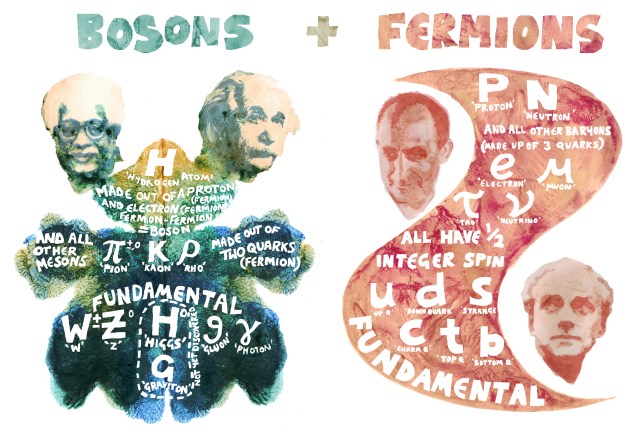
Bosons and fermions by Toya Walker
Satyendra Bose was the first person, I think, to realise that there is a fundamental difference between the particles we now call fermions and bosons.
He came on this realisation by accident, apparently. He was giving a lecture and he made a silly mistake. The lecture was supposed to show how the observed behavior did not match the theory, but because he made a little mistake during the lecture, he ended up showing the theory to work remarkably well. I have been in many lectures that could fit into this class, if they had not ended in a haze of chalk dust and muttering. From what I can gather, Bose’s lecture did not end this way. He realized his mistake immediately, because he was very smart and it was a simple mistake.
The best example I can find to explain simply what he did wrong is on wikipedia, which I trust in all cases other than any discussion of what reality is. Actually wikipedia is also wrong in its description of bosons, but now I’m being sad.
Toss two coins. What are the possible outcomes? Two heads, two tails, or a head and a tail, or a tail and a head. Is that three different outcomes or is it four? In Bose’s mistake it was three. He was going to show how things worked when head+tails was not the same as tails+head. He got it wrong, or maybe he didn’t, maybe it was his brain thinking ahead of the lecture.
For photons and other bosons, head+tails is exactly the same as tails+head.
Bose’s method allowed him to give a description of the way photons behave that fitted really well with what was observed. Nobody understood what he was talking about so he wrote to Albert Einstein, and voila, Einstein made everyone either force themselves to understand or pretend to.
This idea of heads+tails being the same as tails+heads seems pretty obvious to us, but in quantum mechanics this is really not something that can be assumed, because quantum things are completely different to things up here in the big world. In the quantum world swapping things around doesn’t necessarily produce the same outcome.
Bosons, such as photons or the Higgs boson, do not have to be distinguishable. They can all be exactly the same, although with energy around they tend not to be. If you take the energy away, for example if you cool them down so cold that there is almost no energy available to them, they form materials called Bose-Einstein condensates. These conditions give us superfluids (fluids that experience zero viscosity or drag) and superconductors (wires that have seer resistance).
The Pauli exclusion principle and the resulting theory of Fermi-Dirac statistics, and fermions, is a great thing for analogy because it invokes the absolute requirement of individuality. It is a crap thing for analogy because it involves understanding quantum mechanics, which only about four people can manage*. Fermions are not just “punk”, they are incapable of existing in the same state as one another. We are made of these little bits and bobs in our entirety. In fact we consist completely of electrons, up quarks and down quarks, as does all matter on the planet, in the solar system, everywhere. All matter, made up of just three particles, in some configuration, with not one of them being in exactly the same state as any other.
Bosons are not individuals. They are quite happy to be the same. If you rob them of heat and energy they will all become the same: exactly the same. Think you don’t like them? Oh, you do. Light is photons and photons are bosons. Gluons are bosons, and without gluons matter would have no way of holding themselves together. The W and Z are bosons, as is the Higgs. Without these three we would have no stars or planets. They are our heroes. They give us sunshine, superconductivity, lasers, life, planets and stars. They are like the civil service.
An uncharacteristically mature conclusion to this post. We need both the civil service and punks in order to exist.
*Okay. Possibly this is a slight exaggeration.

 Life and Physics