
Well, the fight to stop the decimation of particle, astro and nuclear physics continues.
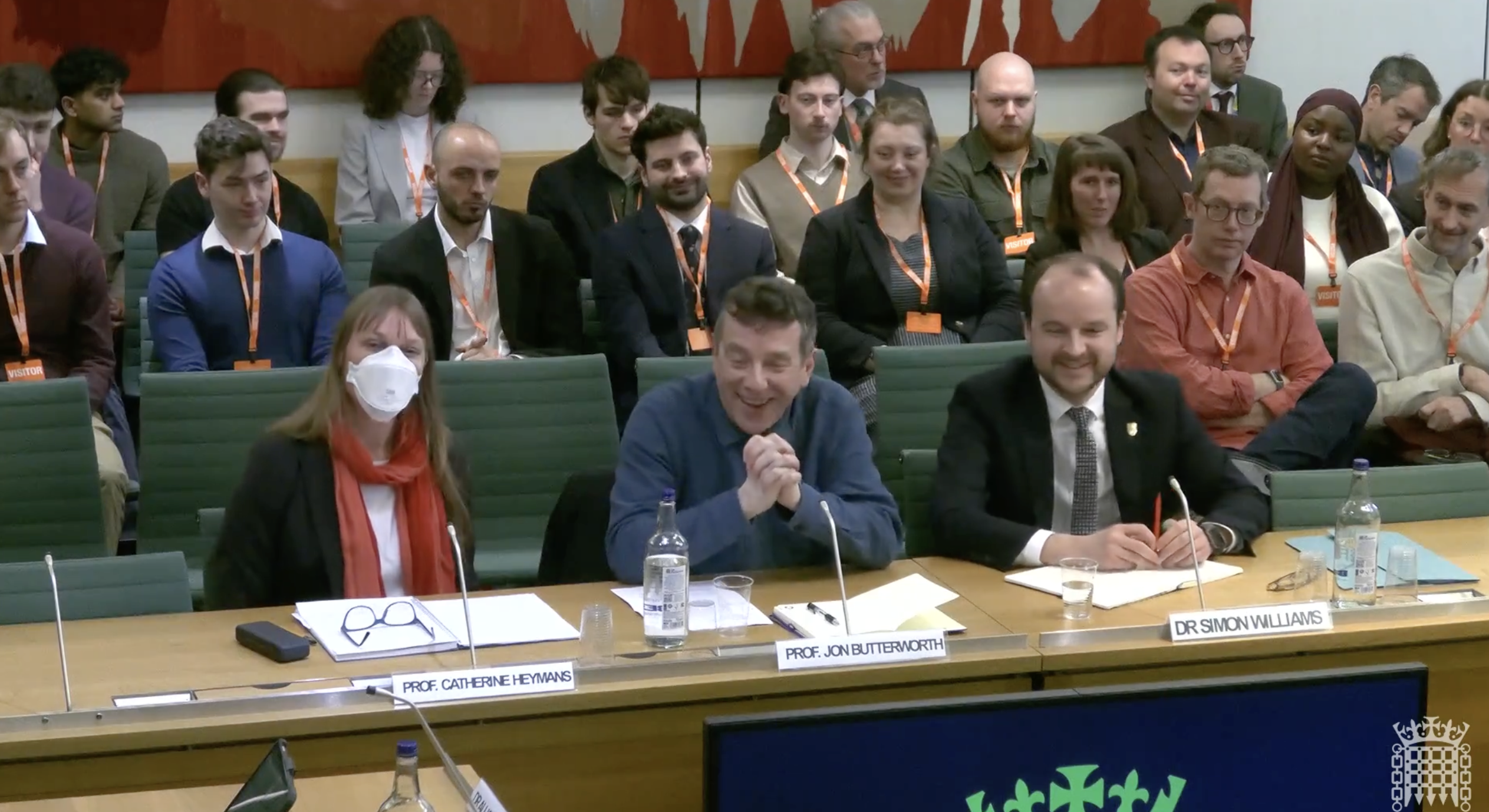
The House of Commons Science, Innovation and Technology select committee session I mentioned in the previous post happened. The above picture is one of the lighter moments in what was an intense couple of hours.
I thought the committee were impressively well informed and on point in their questioning, both of us and of Michele Dougherty, the executive chair of STFC. You can read the transcript, and if you’re really keen watch the recording, on the official parliament site. I think a lot of important information came out. There is a good write-up by Frances Jones in Research Professional, for example.
Also significant was the appearance of the Science Minister, Lord Vallance, and the Secretary of State Liz Kendall, in the House of Lords Science and Technology committee the day before. You can see the transcript and recording here.
The most interesting exchange I took away from this was:
Baroness Willis of Summertown: Can I just follow up on that one, particularly on the STFC? We are hearing that there is a 30% reduction—the budget itself has not changed, but there is a shifting in the budget for STFC, and there is also the removing of the Drayson partitions, which happened in October 2025. The ring- fencing for the blue skies has gone from that structure. Is that understanding correct? Is that what has happened? Is that why we are seeing this pressure on the blue-skies part of that research budget?
Lord Vallance of Balham: STFC has always had this business of doing infrastructure and research.
Baroness Willis of Summertown: But it was partitioned, was it not? It is ring-fenced.
Lord Vallance of Balham: No, there was no hard partition in that. It has always been tensioned against the two things. In fact, it has been quite favourable for the research side for a very long period. My number 1 priority is to protect and grow curiosity-driven research, and I am determined to do exactly that—to protect and grow it. But the real issue at the moment that they have got in STFC is the overspend on facilities. If you look at the international spend, it has gone up by about 20% at a time when domestic spend has gone up at about 11% over a period of six or seven years. That has put big pressure on the overall system. In previous years, the overspend in STFC has then been absorbed by the other research councils, so there has been a strange picture where other research councils have actually ended up having to give money into the system to cover that. We need to fix that. We need a sustainable, proper, well thought-through, structured way to fund the infrastructure. I am very determined that UKRI must find a way to look after so-called PPAN—particle physics and astronomy. All the funding gets tensioned against something. It either gets tensioned against the rest of physics, which might be one way to do it, or you tension it against EPSRC or something. But they are looking at that at the moment.
(My emphasis. See also the Research Professional piece.)
The partitions did in fact exist at some level. The 2010 annual report from STFC contains this from the then CEO, John Womersley:
This good news, together with the publication of the STFC Delivery Plan 2011 – 2015 allows us to move forward with our plans for the coming years. Following the findings of the so-called “Drayson Review,” and the support of Government after listening to our concerns, our Delivery Plan has been structured around the three budgetary partitions announced in March 2010 by the Government – international subscriptions, UK large facilities and our core programme. This approach will avoid the transfer of possible future financial pressures to other parts of the programme, especially university grants, and will ensure that the large facility operations meet the collective needs of the Research Councils.
Obviously institutional memory has been lost at some point, despite the fact that Lord Drayson is actually a member this committee. Maybe the partitions were never “hard”. But they certainly served their intended purpose tolerably well until last year1. In the years after the Drayson Review, stable (although mostly declining, in real terms) funding allowed the UK to have a leading role in two “PPAN” Nobel Prize discoveries: The Higgs Boson and Gravitational Waves.
I’m not sure where the evidence for “favourable for the research side” comes from. It is not really strange that the other research councils “give money into the system” to pay for facilities of which they are by far the principle users. Someone has to pay. And anyway the other councils don’t have their own money to give away, it is all UKRI, and in the end comes from taxpayers.
Regardless, to me the most important statement is the one I emphasised in Lord Vallance’s quote above: “I am very determined that UKRI must find a way to look after so-called PPAN—particle physics and astronomy” (and nuclear).
I’m really glad the problem is so clearly acknowledged by the minister and I really hope “look after” means the UK can carry on being world-leading in this fantastic science.
- They were maintained throughout Brian Bowsher and Mark Thomson’s leadership, see for example the 2016-2020 STFC delivery plan and these slides from 2024 (thanks to Will Barter for the links) ↩︎

 Life and Physics
Pingback: Cuts, Commitments, and Contradictions | Life and Physics
Thank you for posting this Jon, Peter H